Get FREE lab diamond jewellery on purchases over £1,000. Claim yours at checkout.

Your sign to save more, get an extra 20% off with code 'EXTRA20'.

Diamond Guide


book svg

Welcome to Friendly Diamonds! We have created this interactive journey to help you understand what a diamond is, how a lab-diamond is made, its benefits, and explain how it's an excellent choice for your next piece of jewelry.

What are Diamonds??

Diamonds are one of the most stunning and sought-after gemstones on the planet. They are composed of carbon atoms arranged in a crystal structure called a diamond lattice; this gives them their exceptional harness (Mohs Scale: 10) and brilliant sparkle and fire. Diamonds are capable of cutting through almost anything; basically, it takes a diamond to make a diamond.

Diamond Anatomy

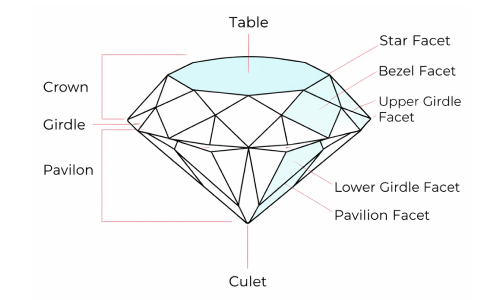
The anatomy of a diamond plays a pivotal role in the way the diamond sparkles, how it looks, and how it is priced. Here’s a detailed breakdown of a diamond’s anatomy:

For better understanding, a diamond can be broken down into two distinctive perspectives: face-up and face-down.

Face-up

In the face-up view, the diamond is viewed from up, exactly how it would look when worn in any jewelry. The key features of a face-up perspective are:

  • Crown: The upper portion of the diamond, including the table and all surrounding facets. The crown's angle and its cut impact the diamond's luster and how light is dispersed.

  • Table: This is the biggest facet on a diamond. The size and proportion of the table facet can affect how light is reflected through the diamond.

  • Girdle: The girdle separates the crown from the pavilion. Its thickness can vary and has a major impact on a diamond’s durability and appearance.

  • Bezel, Star, and Upper-Girdle Facets: These facets close to the table play an important role in directing light into the diamond and enhancing its brilliance.

Face-down

Contrary to the face-up view, the face-down view refers to how the diamond is seen from the bottom. The key features of the face-down perspective are:

  • Pavilion: This is the lower part of the diamond that consists of everything from the girdle to the diamond’s tip, known as its ‘culet’. The cut and depth of the pavilion affect how light is refracted and determine the diamond’s overall sparkle.

  • Culet: This is the tiniest point of a diamond and may sometimes be absent. A well-cut culet is crucial in reducing light leakage and enhancing the brilliance and luster of a diamond.

  • Lower Facets: The pattern, precision, and finish of the lower facets found on the pavilion are crucial for light performance. Its proper alignment and symmetry contribute to a diamond’s overall luster.

The Importance of Anatomy

  1. Luster: The cut, crown, and pavilion finish and angle determine how light is reflected and refracted within the diamond, impacting its overall sparkle and brilliance.

  2. Look: The proportion and symmetry of the diamond’s facets influence how it will look, especially whether it looks true to size.

  3. Value: Well-proportioned diamonds with high-quality cuts are more valuable due to their enhanced craftsmanship and beauty.

Understanding a diamond’s anatomy helps in selecting a diamond that offers both aesthetic appeal and great value.

The 4 C’s (..and more)

A diamond’s value is determined by what the diamantaires refer to as the ‘4Cs’.

Diamonds are precious, but you can find a variety of diamonds in different shapes, sizes, and colors, and they will all be priced differently. Why? Because they are assessed based on their 4 C’s (cut, clarity, color, and carat). These 4 Cs determine the daunting C: COST!

These 4 C’s are the center stone upon which the value and desirability of a diamond are assessed. So, whether you are a diamond connoisseur or are newly navigating through the world of gemstones, understanding the qualities that give a diamond its value is crucial.

Read on to uncover how each diamond’s facet contributes to its brilliance and uniqueness.

Cut

Let’s cut right to the chase.

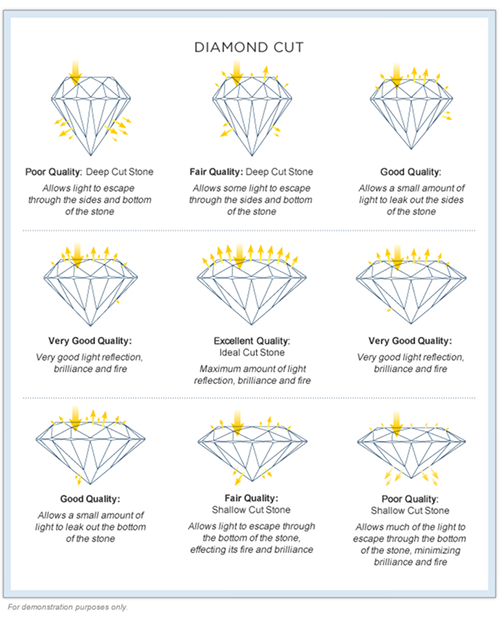
When referring to diamonds, the cut is determined by the craftsmanship of each facet and the diamond’s ability to reflect and refract light. It is the cut of a diamond that determines the diamond's sparkle, brilliance, and overall beauty. A well-cut diamond will be one with exceptional brilliance and fire. On the other hand, a poorly cut diamond may be asymmetrical, lack in brilliance, and have little to no fire. Understanding the intricacies and importance of a diamond’s cut allows you to appreciate and select diamonds that resonate with you.

Do not confuse the cut of the diamond with the shape of the diamond, as they are two very different qualities.

The cut of a diamond plays a crucial role in determining its value and beauty. There is no set standard for what a ‘perfect’ diamond looks like; one individual might find a diamond aesthetically appealing while another may not. This is why certain laboratories such as the Gemological Institute of America (GIA) will only grade a round diamond’s cut, as the cut grade of a fancy-shape diamond is subjective to the consumer. However, other laboratories do grade cut of all diamond sizes.

Diamond grading laboratories have broken down diamond cuts into various grades to help consumers.

  • Ideal Cut: The diamond is perfectly symmetrical, and the facets are all proportionate, which is why diamonds with ideal cuts refract light at their maximum potential. Laboratories such as GIA do not have an ‘ideal cut’; their grading system starts with ‘Excellent’.

  • Excellent Cut: Excellent cut diamonds have amazingly cut facets; all facets are symmetrical and proportionate, they are even in pattern, which is why they sparkle amazingly.

  • Very Good Cut: Very Good Cut diamonds are usually evenly polished and sparkle in a great way. They are also considered symmetrical and have proportionate facets.

  • Good Cut: Good cut diamonds have a fine sparkle, and the polish level and symmetry are also credible. They have fairly good facet proportions.

  • Fair Cut: Diamonds with a fair cut fall under a lower category in terms of sparkle and polish, and they are not necessarily symmetrical and don’t necessarily have proportionate facets.

  • Poor Cut: Diamonds with a poor cut are not polished well, with uneven spots on the surface. These diamonds may also lack sparkle and be dimmer.

To better understand the importance of a diamond’s cut, here is a visual representation of a round diamond within every cut grade.

Clarity

Like a diamond’s cut, its clarity is also a deciding factor in its value and overall beauty.

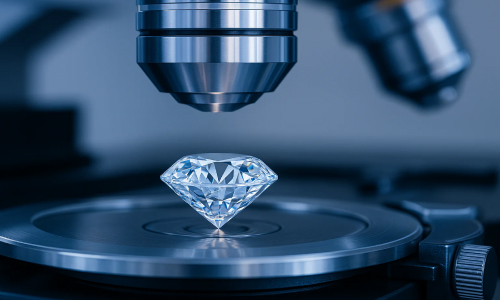
A diamond’s clarity is graded based on its blemishes, inclusions, or lack thereof. Blemishes refer to any surface characteristics such as scratches, polish lines, nicks, burns, surface graining, and more. Inclusions refer to characteristics found inside a diamond such as feathers, clouds, etch channels, and more. These blemishes and inclusions can affect a diamond’s overall appearance and its ability to let light pass through.

Deciding which diamond clarity is right for you is a subjective choice. There is no one correct answer; some people may prefer a diamond with a higher clarity grader for its pristine appearance, while someone else may appreciate the lower clarity characteristics of a diamond. Diamond grading laboratories such as GIA and IGI have created a structured system for evaluating diamond clarity, providing a standardized procedure to assess its characteristics. You should note that different grading laboratories may grade the diamond slightly differently.
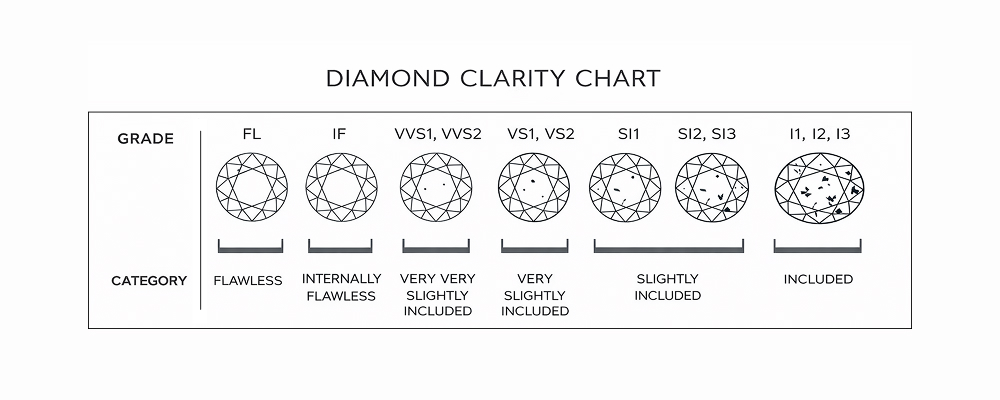
The grading system ranges from Flawless (FL) to Included (I):

  • Flawless (FL): Flawless diamonds are the rarest and most valuable stones, as their surface is smooth (blemish-free) and the diamond has no inclusions, making them shine the brightest.

  • Internally Flawless (IF): Like FL diamonds, IF diamonds are also inclusion-free but differ because they contain certain surface-blemishes. These diamonds are nearly perfect.

  • Very Very Slightly Included (VVS1 and VVS2): To the naked eye, these diamonds are inclusion-free. They consist of very minor inclusions that can only be seen by a trained professional with a magnifying loupe or a microscope. VVS1 is slightly less included than VVS2.

  • Very Slightly Included (VS1 and VS2): VS1 and VS2 stones consist of minor inclusion that can be seen if examined closely.

  • Slightly Included (SI1 and SI2): SI1 and SI2 (and sometimes SI3) diamonds contain inclusions (and blemishes) that are visible to an untrained eye also.

  • Included (I1, I2, I3): Included diamonds have inclusions (and blemishes) that are clearly visible, even without the aid of a loupe or microscope. I3 is the lowest clarity a diamond can obtain.

For better understanding, here is a visual representation of a round diamond from every clarity grade mentioned above. We hope this has been flawlessly explained.

Color

We are thrilled to see ‘hue’ made it so far!

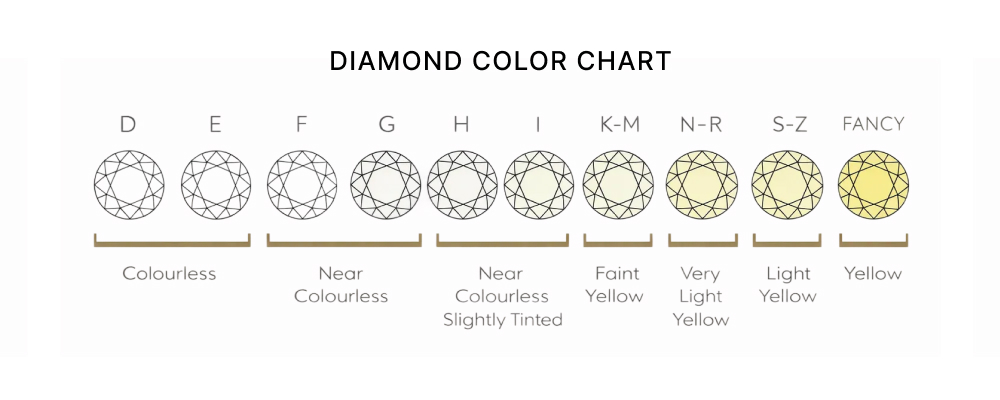
The third C stands for ‘color’. While examining the color of a diamond, its hue, tone, and saturation are taken into consideration. These factors affect the transparency, rarity, and value of a diamond. When diamonds contain no additional elements in their chemical composition, they look colorless- this is one of the highest values a diamond can have. Diamonds are graded on a scale of D to Z. Diamonds graded on this scale are graded based on their absence of color, with D being considered the most colorless. Anything beyond Z is considered ‘fancy colored’.

While the diamond color may be difficult to examine without training, it plays a major role in its price. Seeking an expert’s opinion is crucial when choosing the best color for your diamond. As mentioned previously for the cut and clarity, there is no color that trumps another. In terms of demand, customers tend to prefer colorless diamonds or fancy colored diamonds. Grading laboratories created the diamond color scale to help customers examine the color of their diamond.
  • Colorless (D, E, F): These are your colorless diamonds. Face up or face down, there is no color in these diamonds. Within the D-Z scale, these are typically the most sought-after diamonds.

  • Near Colorless (G, H, I, J): These are the diamonds that face-up have no color but face-down appear very faintly colored (usually yellow or brown). These can be great colors to buy if you would like to be a little kinder to your pockets without seeing any difference face-up.

  • Faint (K, L, M): Faint-colored diamonds are the ones where, face-down, you can see prominent color, and face-up, you can see very faint color.

  • Very Light (N, O, P, Q, R): In these diamonds, the color is quite prominent face-up and face-down.

  • Light (S-Z): Light diamonds have a prominent color and are one step away from being considered ‘fancy-colored’.

At Friendly Diamonds, we don’t manufacture or sell diamonds that are below M color.

Carat

Carat is the last key factor in determining a diamond’s value. Carat refers to a diamond’s weight, which in turn determines its size. While many people consider the carat weight to be a determinant of a diamond’s size, this can be misleading as certain attributes, such as the cut or shape, can have a significant impact on its size. One carat is equivalent to 200 milligrams, or 0.2 grams.

We’ve all heard the saying ‘the bigger the better’, right? This may not be the case when it comes to purchasing a diamond. Yes, you may come across a bigger diamond that is more affordable than a smaller one and think you have hit the jackpot. While the diamond may be cheaper, it might be because of its lower cut, clarity, or color grade. Knowing which attributes you prefer is what is most important.

5th C: Credibility

Often overlooked, Friendly Diamonds has decided to emphasize the 5th C: credibility.

We want you to fully trust us with your diamond needs and will provide you with all the necessary information to make this possible.

In order for a diamond to be credible, certain criteria must be ticked:

  1. Certification: Remember the 4 C’s above? These are all graded on certain scales by trained diamond experts. Once graded, a certification with all the diamond’s characteristics is available for you to view and evaluate.

  2. Reputation: A reputable website or store will be able to ensure that every diamond is ethically sourced and comes from trusted vendors. This is a crucial factor, as you want to be confident with your purchase.

  3. Expertise: Picking the ‘right’ diamond is no walk in the park! We hope we have made the process a little easier for you. However, we still highlight the importance of consulting a diamond expert before making your final decision. With the correct expertise, you can be guided with the utmost care and consideration for your needs.

BONUS C: Confidence

None of the C’s above matter if you are not confident with your purchase. At Friendly Diamonds, we hope to ensure that you are happy and satisfied with the diamond you selected. And to help with this C, we are happy to provide you with all the guidance and information you require!

Fancy Colored Diamonds

Fancy-colored diamonds are a rare category of diamonds celebrated for their vibrant hues. Traditionally, diamonds are graded on the GIA D-Z color scale, but fancy-colored diamonds are not evaluated within this range. Unlike the D-Z scale that measures the absence of color, the fancy color scale measures the presence of color. They are, instead, graded on a different scale that focuses more on the diamond’s hue, tone, and saturation.

Hue: Defined as the color of the diamond- for example, is the diamond pink? Is it yellow?

Tone: Refers to the lightness or darkness of the color- is it a light blue? Is it a dark yellow?

Saturation: Refers to the intensity of the color- is it a vivid yellow?

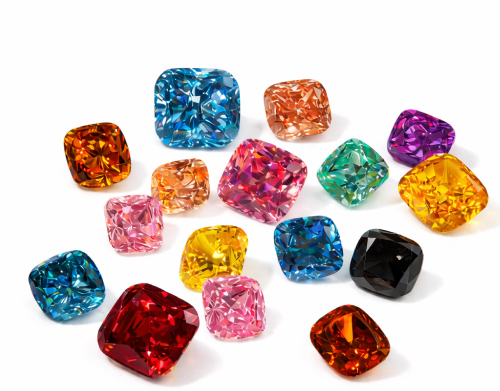
Diamonds come in a variety of colors, each having its own unique beauty. While some may prefer a colorless diamond, others may opt for a fancy colored diamond. The most popular diamond colors include yellow, pink, blue, green, and brown.

Fancy colored diamonds are graded into the following categories based on the color strength (least intense to most intense).

  • Faint

  • Very Light

  • Light

  • Fancy Light

  • Fancy

  • Fancy Intense

  • Fancy Vivid

  • Fancy Dark

  • Fancy Deep

Fancy Yellow Diamonds

Fancy yellow diamonds are the most popular diamond color. Majority of fancy colored diamonds are yellow. This hue comes from nitrogen in the diamond’s lattice structure.

Fancy Pink Diamonds

Fancy pink diamonds are among the rarest diamond colors available. Unlike with yellow diamonds, experts are yet unsure about what creates a pink hue in diamonds; they believe that it may be due to an atomic-level lattice defect.

Fancy Blue Diamonds

Fancy blue diamonds get their hue from the element boron (B). It is one of the rarest diamond hues available, making it incredibly sought after and appreciated.

Fancy Green

Fancy green diamonds are rare and distinctive due to their unique color. The green color in diamonds results from the presence of certain elements and radiation exposure, which affects the diamond's crystal structure.

Fancy Brown

Fancy brown diamonds are among the most common fancy colored diamonds. They are also referred to as ‘champagne’ or ‘cognac’ diamonds, and nitrogen (N) is responsible for a diamond’s brown hue.

Diamond Shapes

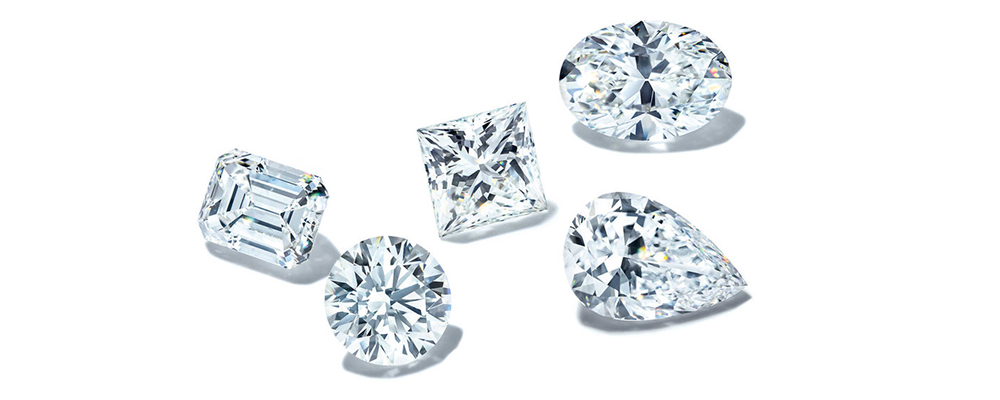
Diamonds are cut into various shapes, each having its own distinct style and brilliance. Generally, these fancy shapes fall into one of two categories: brilliant cuts and step cuts. Each category has a range of shapes with distinct characteristics and visual effects. Let’s dive deeper into both categories and how they differ from one another.

Characteristics

Brilliant Cut

Step Cut

Facet Arrangement

Multiple facets (typically 57 or 58 in round diamonds).

Triangular or kite-shaped facets.

Fewer, larger, parallel facets.

Rectangular or trapezoidal facets.

Brilliance

Maximizes brilliance and fire.

Emphasizes clarity and color.

Shape

Round, pear, marquise, princess, radiant, oval, heart, and more.

Emerald, baguette, tapered baguette, and more.

Brilliant Cut

Brilliant cut diamonds are incredibly popular in jewelry since they are precisely designed to maximize the diamond’s ability to reflect light, resulting in phenomenal brilliance and fire. In the early 20th century, Marcel Tolkowsky calculated the ideal proportions for a round diamond’s optimum brilliance. Since then, the brilliant cut has become the standard for diamond cutting.

Of all the various shapes found within brilliant cut diamonds, round diamonds are the most popular. Every shape offers its own set of qualities that make it unique and desirable. The table below explains how the faceting of each shape affects its perceived size, surface area, and brilliance:

Shape

Description

Surface Area

Perceived Size

Brilliance and Fire

Round

The most classic shape, consisting of 57 or 58 facets. Popularly known for its optimal light performance.

High crown surface area.

Appears smaller due to its deeper cut (high pavilion depth).

Highest brilliance and fire due to optimal light reflection.

Oval

Elongated round diamond, offering a larger surface area.

Higher surface area than a round.

It looks larger due to its elongated shape.

High brilliance and fire.

Pear

In the shape of a teardrop, a hybrid of a marquise and round diamond.

Larger surface area on the crown.

Appears bigger due to its elongated shape.

High brilliance, but may contain a ‘bow-tie’ effect, making the diamond appear black in the center.

Marquise

Resembling the shape of a boat, with pointed edges on both ends.

Very large surface area.

Looks largest when compared to other shapes of the same carat weight.

High brilliance and fire, but may contain a ‘bow-tie’ effect, making the diamond appear black in the center.

Heart

Resembling the shape of a heart, with a cleft at the top.

Large surface area.

Appears larger due to its wide shape and deep cut.

High brilliance and fire.

Cushion

A square or rectangular shape with rounded corners. Has a vintage appeal.

Average surface area, not too large or small.

Appears smaller due to its deeper cut.

Good brilliance.

Radiant

Square or rectangular in shape, with trimmed corners that resemble those of the emerald cut.

Average surface area.

Appears slightly smaller than a round.

Excellent brilliance and fire.

Princess

A square shaped diamond with incredible brilliance.

Smaller surface area.

Appears smaller due to its pavilion depth.

Incredible brilliance, second to round diamonds.

Asscher

Square with deeply cut corners, step cut with brilliant-cut facets.

Smaller surface area than other brilliant-cut diamonds.

Appears smaller due to its pavilion depth.

High brilliance

Step Cut Diamonds

Step cut diamonds are popular for their classy and sophisticated appearance; they are characterized by their large, flat facets that create prominent looks and highlight a diamond’s clarity and color. Popular during the Art Deco era, step cut diamonds have become increasingly in-demand for classy, timeless engagement rings and jewelry.

We have made this table to help you better understand the characteristics of a step cut diamond and how its shape impacts the appearance and brilliance.

Shape

Description

Surface Area

Perceived Size

Brilliance and Fire

Emerald

Rectangular-shaped diamond with trimmed corners. One of the most sought-after step cut diamond shapes.

Large table and open facets.

Appears larger due to the elongated shape and large table.

Lower brilliance and fire, emphasis mainly on clarity and color

Asscher

A hybrid cross of a square with the facetting and corners of an emerald.

Medium surface area.

Appears smaller due to depth but is popular because of its unique shape.

Lower brilliance, highlighting mainly on clarity and color.

Baguette

Rectangular diamonds with pointed edges, oftentimes used as side stones in engagement rings.

Small surface area.

Appears smaller, a good way to complement center stones.

Minimal brilliance, more about linear light flashes.

Tapered Baguette

Like a baguette, but the widths of the diamonds are not the same. The perfect diamonds to use as side stones in jewelry.

Small surface area.

Appears smaller, a good way to complement center stones.

Minimal brilliance, more about linear light flashes.

Diamond Grading Certificates

Diamonds are certified by institutions and laboratories that grade diamonds based on the 4Cs- cut, color, clarity, carat. There are many leading institutions for diamond grading; getting a diamond certified is a crucial step to ensure that you are confident with your purchase.

The Importance of Diamond Grading Institutes

These grading institutes play an important role in providing reliable and consistent grading standards. Their certifications help ensure trust and transparency between buyers and sellers, making diamond transactions more secure and reliable.

Gemological Institute of America (GIA)

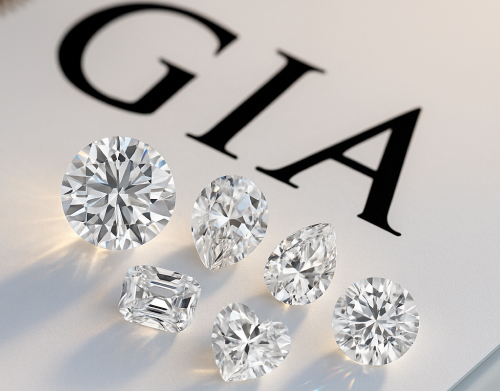
The Gemological Institute of America (GIA) is one of the respected and widely recognized diamond grading institutions in the world. It was established in the early 1930s and is known for its consistent grading standard and its incredible reputation within the diamond industry. A GIA diamond grading report provides a comprehensive evaluation of a diamond’s key characteristics, including the 4 C’s while also mentioning any comments on the diamond’s fluorescence and its exact measurements.

GIA is also merited for its incredibly easy-to-use website where every certified diamond can be found, further increasing a buyer’s reliability in the certification.

How to Understand the Certificate?

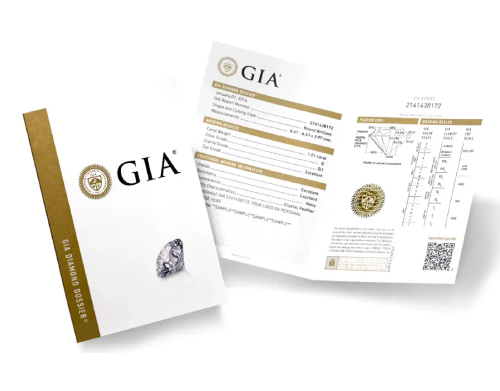
The GIA certification is incredibly easy to understand. Let’s break it down:

  • GIA Report Number: This is the unique number given to a particular diamond. If this number was entered into the ‘GIA report check, the details surrounding this diamond would be available for you to see.

  • Grading Results: This is where you will find the 4 Cs- cut, color, clarity, carat. However, GIA only grades the cut of round diamonds, and no fancy-shapes as they believe that the cut of fancy shaped diamonds is subjective and every individual will have a different opinion of what is appealing and not. This is why this certification only has 3 results: carat, color, clarity.

  • Inscription: The diamond’s inscription number will always be the same as its Report Number. This is to ensure any buyer that the diamond they have purchased is matching with its certification. It is incredibly important to always verify that the certificate and diamond have the same number before purchasing.

International Gemological Institute (IGI)

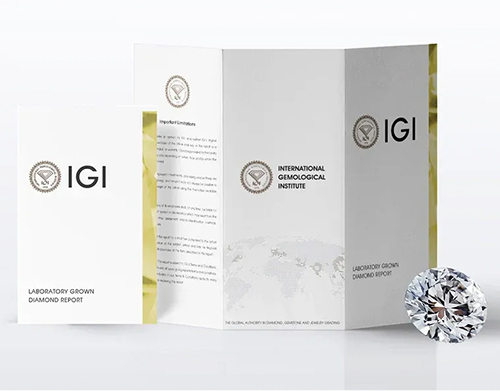
Like GIA, the International Gemological Institute (IGI) is a leading authority in the field of diamond grading and certification, known for its global reach and accessible approach. IGI was founded in the mid-1970s and is increasingly popular in Europe and Asia. Similarly to GIA, an IGI report also contains all the information regarding the 4 Cs.

There are many other grading institutions, such as the American Gem Society (AGS), Hoge Raad voor Diamant (HRD), and European Gemological Laboratory (EGL), each with its own grading standards and report formats.

Diamond Care

Diamonds are renowned for their beauty and durability, but in order to maintain their sparkle and value, proper diamond and jewelry care is essential. Here are a few ways in which you can maintain your diamond jewelry.

Regular Cleaning

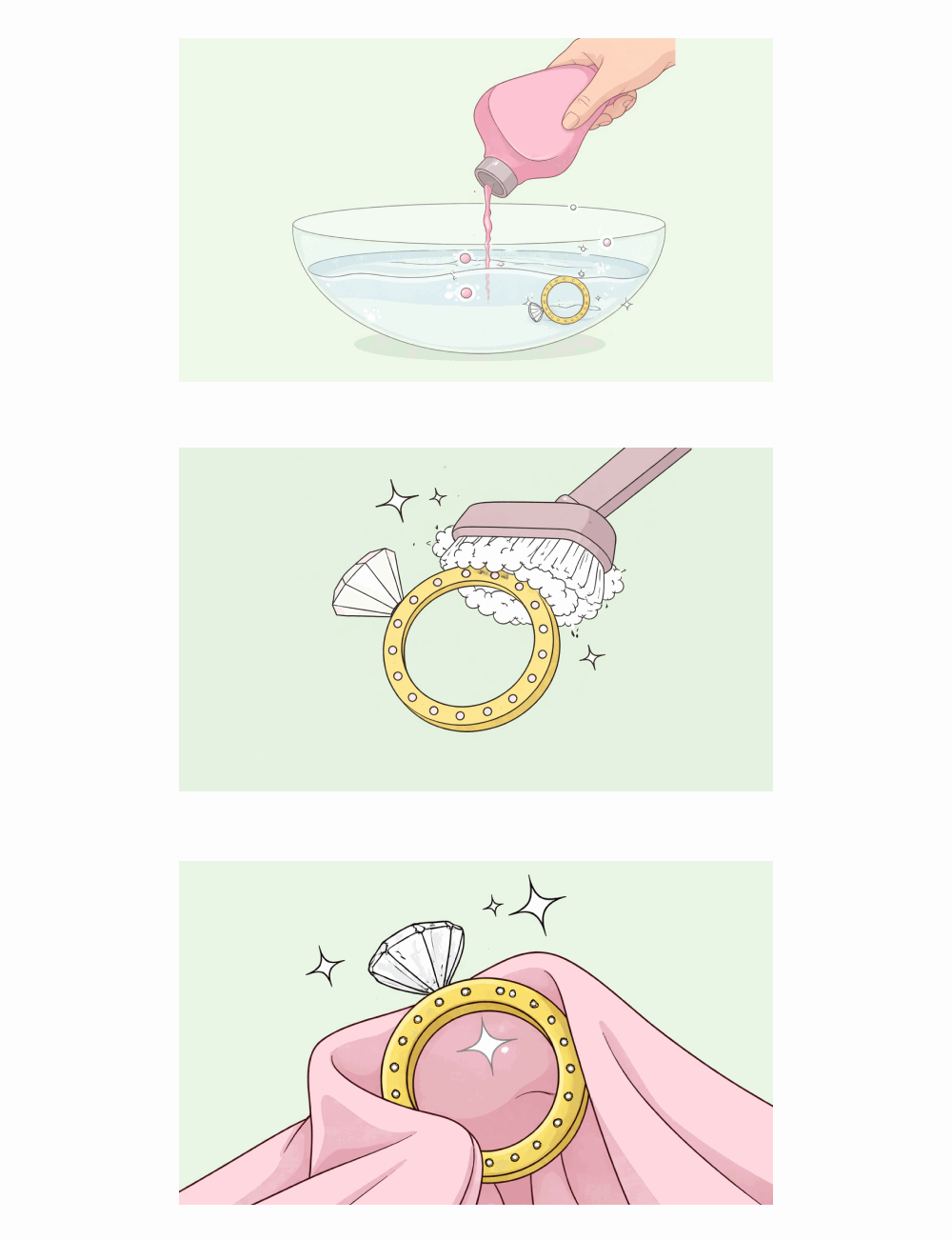
Diamonds can attract dust, dirt and oils (even from our body). All of this can dull a diamond’s brilliance. Here is how you can clean your diamond and diamond jewelry regularly to maintain its luster.

  • At home: Soak your diamond/jewelry in a mixture of luke-warm water and mild dish soap. After allowing it to soak for 20-30 minutes, carefully remove the diamond/jewelry and use a soft-bristled toothbrush to remove any remaining dirt. The soap will allow you to rid the diamond of any excess oils or dirt and the brush will remove dirt.

  • Professionally: While at home cleaning is beneficial, it may be advisable to get your jewelry cleaned professionally sometimes. This is to ensure that it is being cleaned as well as it can be.

Safe Storage

While cleaning your jewelry will rid it of a lot of residue, storing your jewelry securely will prevent it from developing scratches, chips and damage.

  • Keep your diamonds separate while storing them at home. This prevents scratching. Furthermore, when traveling, ensure to carry your jewelry in travel pouches with compartments to ensure that they do not touch and scratch each other.

Avoid Harsh Chemicals

This is specifically for jewelry- as harsh chemicals such as chlorine can damage the metal setting around your jewelry. Remove your diamond jewelry while completing household chores using cleaning products containing chlorine and other harsh chemicals.

Be Mindful

Yes, diamonds are incredibly durable. However, certain activities can put your diamond jewelry at risk of unnecessary wear and tear.

  • Remove your jewelry prior to taking part in any physical activities (such as swimming, gardening, heavy lifting, or any sports).

  • Be mindful of applying lotions, perfumes, oils before wearing your jewelry as these products can leave residues.

Regular Appraisals

Regularly giving your jewelry for appraisal is incredibly important to make sure that the value of your pieces are up-to-date.

  • Normal wear-and-tear of your jewelry can impact its value and resale amount. Furthermore, market value for diamonds and metals is constantly being revised, so it is essential to make sure that your jewelry is valued according to the latest prices.

By following these care tips, you can ensure that your jewelry shines and sparkles like it did when you first bought it. For more information on how to care for your jewelry, do not hesitate to contact our customer support team.

Lab Diamonds

Lab grown diamonds are diamonds grown in laboratories under controlled environments and conditions. Lab grown diamonds possess identical chemical, physical, and optical properties as that of a natural diamond.

This table helps better understand the difference between a lab grown diamond and a natural diamond.

Characteristic

Lab Grown Diamond

Natural Diamond

Formation

Created under controlled laboratory environments and conditions using High Pressure High Temperature (HPHT) or Chemical Vapor Deposition (CVD) procedures.

Formed naturally under high pressure and high temperature over billions of years in Earth’s crust and mined.

Cost

$$

Significantly cheaper than a natural diamond

$$$$$

More expensive due to the mining procedures

Chemical Composition

Carbon

Carbon

Time Taken to Grow

30-40 days

Millions of years

Conflict Free?

Yes

No

Hardness (Mohs)

10

10

How are lab grown diamonds formed?

Lab grown diamonds are formed in controlled environments and conditions in a laboratory. They are created in one of two ways: High Pressure High Temperature (HPHT), or Chemical Vapor Deposition (CVD). Both processes ensure that it is near impossible to identify the difference between lab grown diamonds and natural diamonds unless you’re an expert gemologist or have a diamond tester machine.

High Pressure High Temperature (HPHT)

HPHT was the first method designed to manufacture lab grown diamonds. Think of this process as creating a diamond in a super-hot, super-pressurized oven, where the diamond “bakes” and grows from a tiny seed. The HPHT process begins with a small diamond seed that is placed in a state-of-the-art machine that mimics the natural conditions under which diamonds are formed in the Earth’s crust. This machine then creates extremely high pressure and high temperature, to create the damond. Carbon atoms begin to attach to the diamond seed and crystallize, growing layer by layer into a larger diamond.

Eventually, when the diamond reaches the manufacturer’s desired size, the pressure and temperature inside the machine is gradually reduced and the diamond is carefully removed.

Chemical Vapor Deposition (CVD)

Imagine a high-tech greenhouse. In the middle of this greenhouse, there is a tiny seed that thrives and relies on carbon atoms as its ‘nutrients’ to facilitate its growth layer-by-layer.

This is basically the essence of the CVD process. Here, a small diamond seed is placed in a vacuum filled with carbon-rich gasses like methane. The chamber is then heated and the carbon atoms settle onto the diamond seed, crystallizing into a bigger diamond layer by layer. This process is controlled and surveillance carefully to ensure that the lab grown diamonds are formed correctly, resulting in high-quality diamonds.

Both of these processes allow us to create diamonds in a laboratory, providing a sustainable and ethical alternative to mined diamonds.

Lab vs Simulants

Lab-grown diamonds are different to simulant diamonds. While both can be used in jewelry, lab-grown diamonds are the preferred choice for an optimum sparkle and unmatched beauty.

What are Diamond Simulants?

A diamond simulant is a material that is designed by humans to look like a diamond. However, it does not possess the same chemical, physical or optical properties as a lab-grown diamond. Oftentimes, simulants are used as a more affordable alternative to diamonds in jewelry, even though they do not offer the same sparkle or luster.

To better understand the difference between lab-grown diamonds and simulants, here are their key characteristics:

Characteristic

Lab-Grown Diamond

Diamond Simulant

Chemical Structure

Formed by pure carbon in an intact carbon lattice

Composition varies

Manufacturing Process

HPHT or CVD process

Manufacturing varies

Hardness

10 on the Mohs Scale

Varies depending on which simulant it is (cubic zirconia, moissanite, glass)

Appearance

Identical to mined diamonds; same luster and brilliance

Has different optical properties, light play is different

Cost

$$

$

Slightly cheaper than lab-grown diamonds

Durability

Extremely durable

Durability lower and more prone to scratches due to lower Mohs scale

Common Uses

High-end and fine Jewelry

Typically opted for in costume and fashion jewelry